
Today we are going to talk about creating your very best Tchaikovsky music lesson. Tchaikovsky has some great music that is definitely worth sharing in your classroom, but sometimes it can be hard to come up with fun ideas of how to share and interact with the music.
So I’ve compiled a list of some fun Tchaikovsky music activities you can try in your classroom to expose students to the music of this famous composer.
Or, if you are in a hurry and would just like something ready made – you can grab my Music of Tchaikovsky Unit for Elementary Music. It has listening, coloring and movement activities as well as activities to learn about composer Pyotr Tchaikovsky.
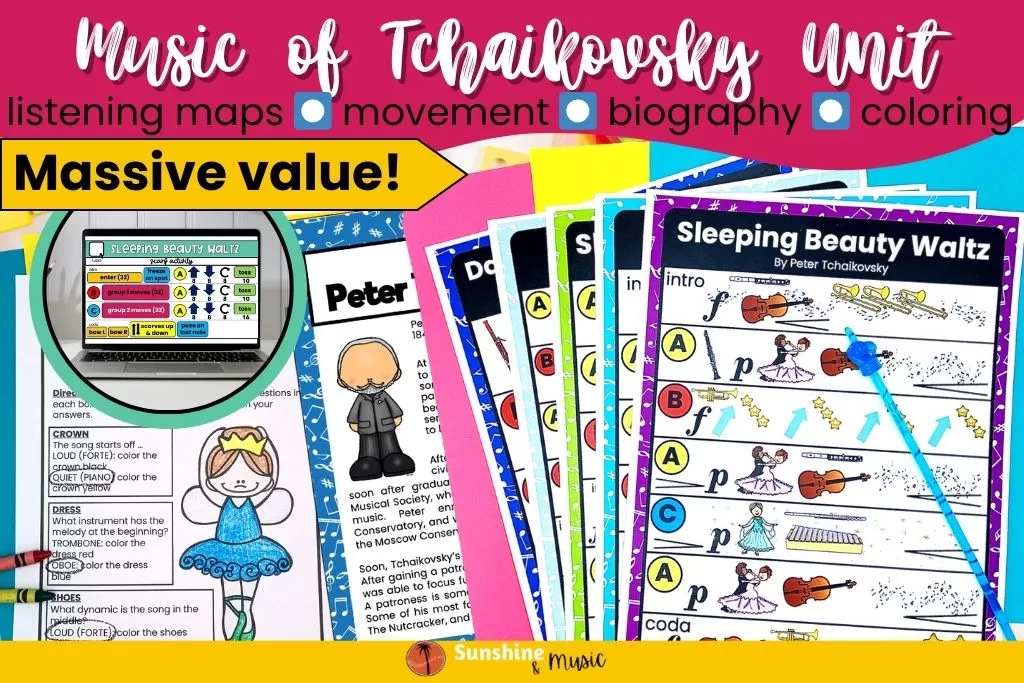
Tchaikovsky Biography
If I am doing a unit on a specific composer, you had better believe that we are going to get into their biography a bit. But learning about a composer doesn’t have to be boring. Here are some of the ways to shake it up:
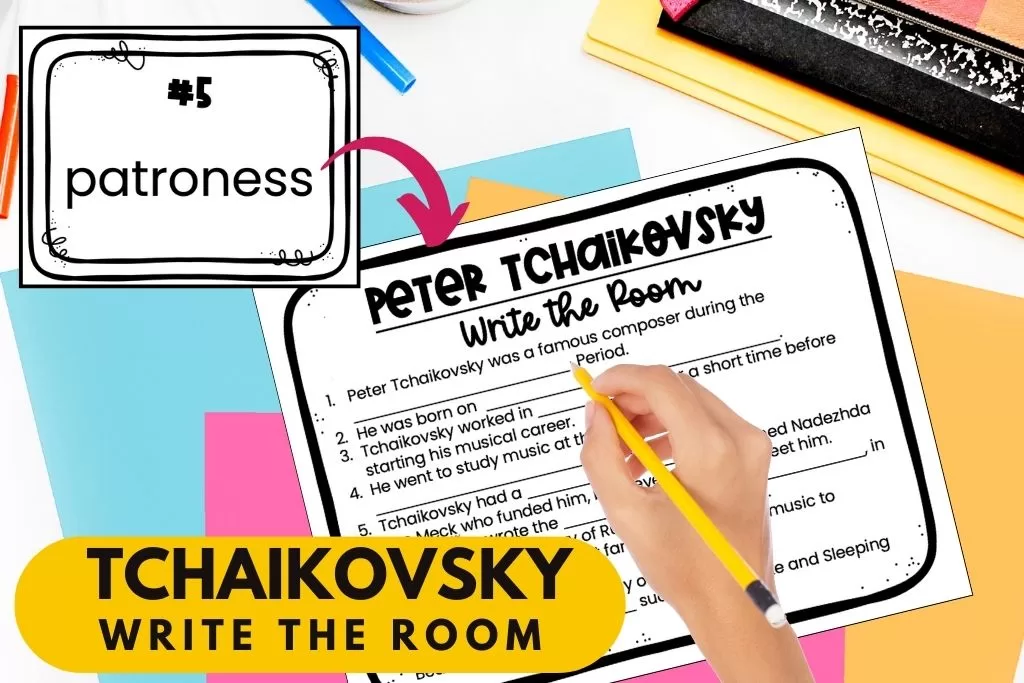
Tchaikovsky Facts Write the Room
Hide posters around the room. Students have to find the posters and write the words in the blanks that correspond with the number on the poster. Through this activity they discover fun facts about Peter Tchaikovsky and his music.
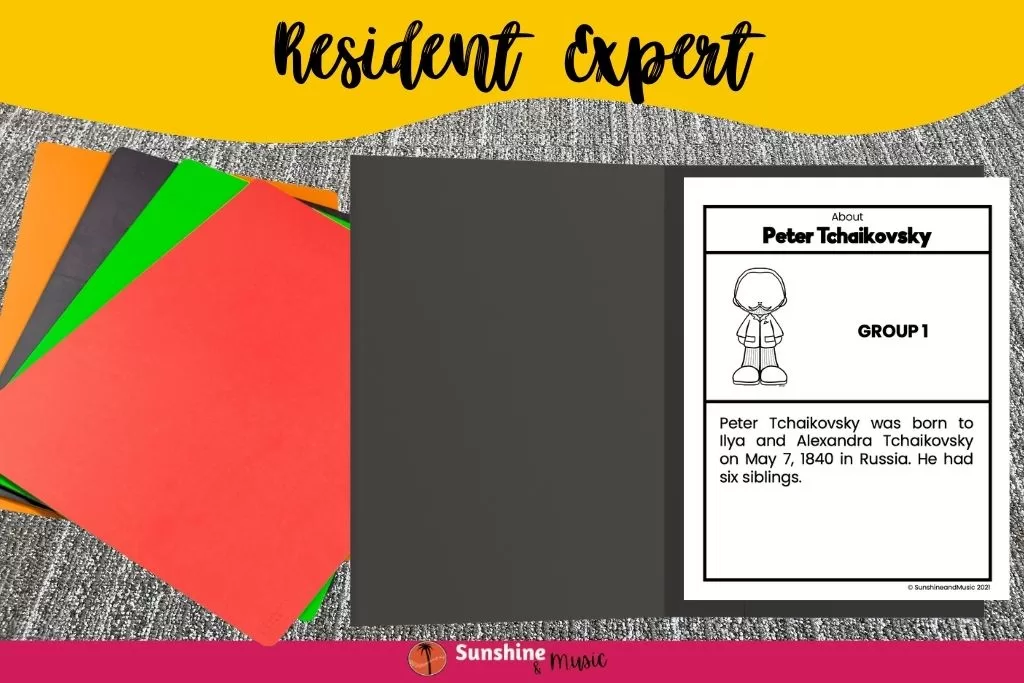
Resident Expert on Tchaikovsky
Have students form groups. Each student is in charge of learning one bit of information about the composer. Then they have to teach their group mates.
Quiz and Swap Tchaikovsky Facts
Have questions about Tchaikovsky written on little cards. I like to do them as multiple choice questions, but you could also try fill in the blank or other formats. Students quiz each other on the question, then swap cards and find a new partner. My students love getting to circulate around with their classmates.
Depending on how well I want students to know the information, I may have some sort of accountability at the end, ranging from sharing something you learned to a full-blown quiz. Teacher vs student game-show is often popular in my class (if they get it wrong, I get a point and if they get it right, they get the point).
I have all three of the activities mentioned above (Quiz and Swap, Resident Expert, Write the Room) included in my Tchaikovsky biography pack plus seven other activities like a word search and interactive notebook. This Tchaikovsky Biography Pack is included in my Tchaikovsky Music Bundle.
Pyotr Tchaikovsky – Famous Works
When you think of Tchaikovsky, your mind likely jumps to The Nutcracker, but what about Tchaikovsky’s other famous works? Think of the 1812 Overture. Or Tchaikovsky’s other famous ballets like Swan Lake or Sleeping Beauty. And then there are his symphonies, Romeo and Juliet – the list goes on and on.
My goal in this post is to share the music outside of the Nutcracker, both because the Nutcracker is so well known and because it sort of feels like something that I should only be teaching around Christmas time. But I do have a separate post all about lessons for the Nutcracker.
For now, let’s check out some of Tchaikovsky’s other famous works that your students are bound to love.
Music of Tchaikovsky 1812 Overture
Of course Tchaikovsky’s 1812 Overture is first on the list. Some might even argue that this one is MORE famous than the Nutcracker. Who knows? But one thing is for sure. This song is so much fun!
Now, I should clarify, when I say the 1812 Overture, I don’t mean the ENTIRE overture, which clocks in at over 15 minutes! I am talking about the finale, which is much shorter at around 3:00 long. So when you are searching Apple Music or whatever platform you use, make sure to type in 1812 Overture FINALE. It should start out with the sound of bells.
Ok, now that we are all talking about the same music, let’s talk about my favorite activity for the 1812 Overture Finale. It’s a parachute activity!
You can watch the entire 1812 Overture Parachute Activity in action here. It is so. much. fun!
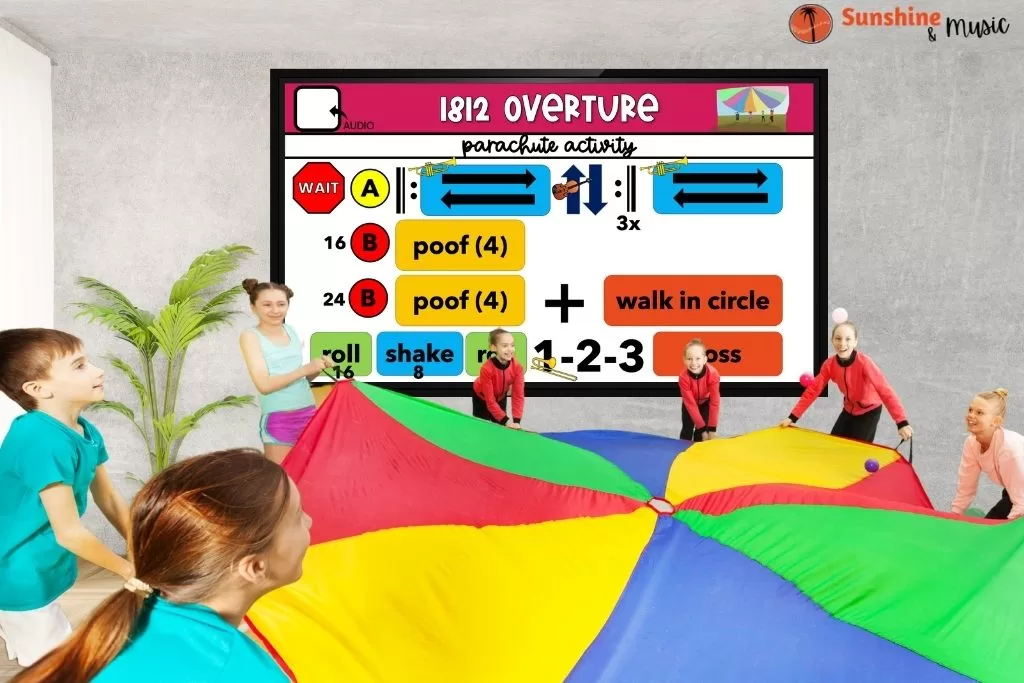
I have a helpful set of movement visuals that you can display on your board as the music plays. They are included in the Music of Tchaikovsky Unit Bundle. I highly recommend using a visual to keep the activity going smoothly. I secretly use them to remind myself of what is coming up next, but they are helpful to students too, who might not be able to hear your directions being shouted over the music.
Looking to dive a little deeper into the music? You could lead a discussion about what the music makes them think about and why. If I were to do this, I might start with a listening map (also included the Tchaikovsky Music Bundle, hear the song once, talk about it, and THEN do the parachute activity. But you could do it in reverse too.
You could even explain to them about why this piece was written. In fact, I get a little bit into the interesting history of this piece in this blog post about the 1812 Overture. What a great way to tie history in with music! If you really wanted to dive all in, you could start a discussion about other songs that have been created in reaction or in commemoration of world events (We Are the World, songs written for World Cup, Olympic Fanfare, protest music, etc).
Music of Tchaikovsky Swan Lake
Tchaikovsky’s Swan Lake is probably a little less well known, but there are still several iconic themes from the ballet that your students might recognize.
Swan Theme from Tchaikovsky’s Swan Lake
The Swan Theme is probably the most recognizable music from Swan Lake, so that is where I would start.
This could be a great piece for movement, but you could also go a different route. Sometimes, you just need a low key listening activity – like a listening glyph. It’s basically guided listening through coloring.
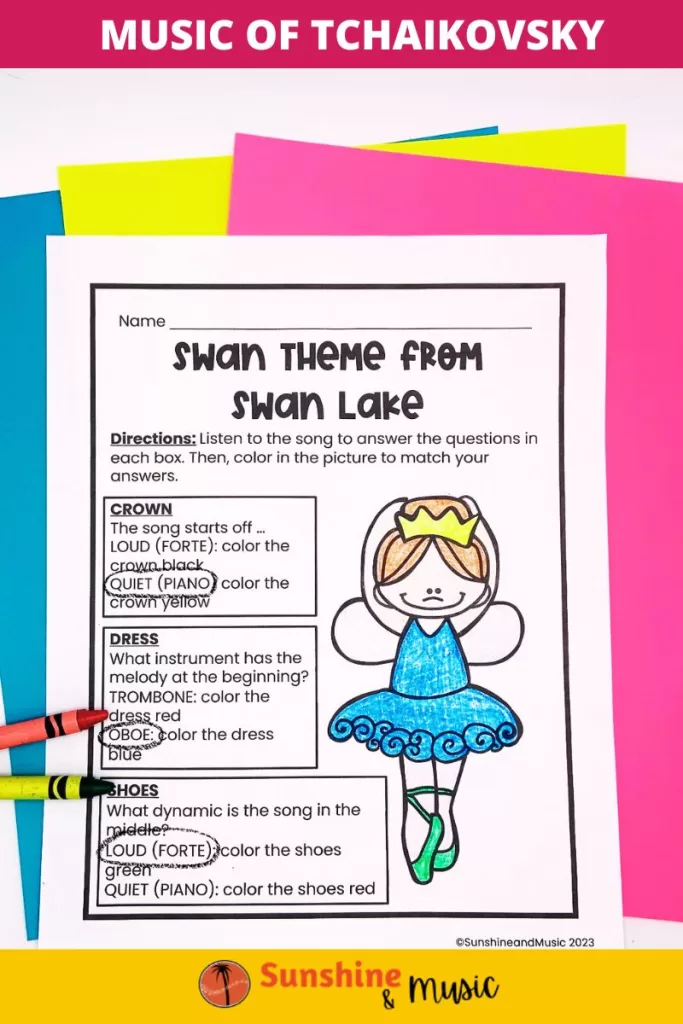
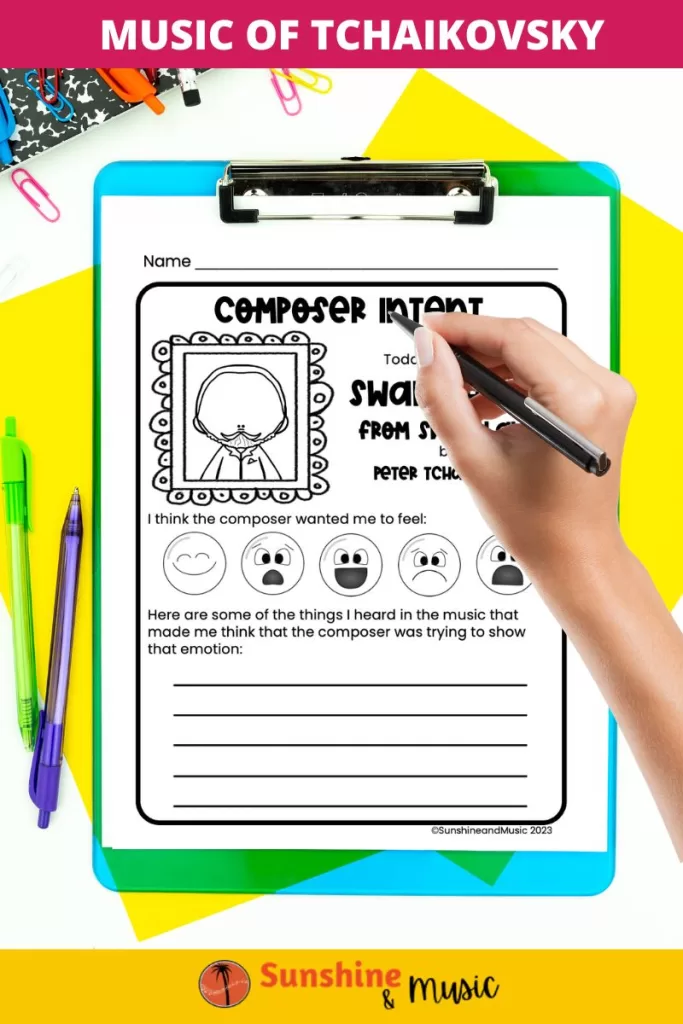
Students listen to the piece and color the picture based on what they hear in the song.
After listening and coloring the worksheet, you could take some time to discuss what you think this song is about and why Tchaikovsky chose to create the piece the way he did. Why were some sections loud and others quiet? What feeling do you think he was trying to create?
You could even have students fill out a worksheet, like this composer intent worksheet, which is included in the Tchaikovsky Music Unit Bundle. This could be done independently or in small groups.
Dance of the Little Swans from Swan Lake by Tchaikovsky
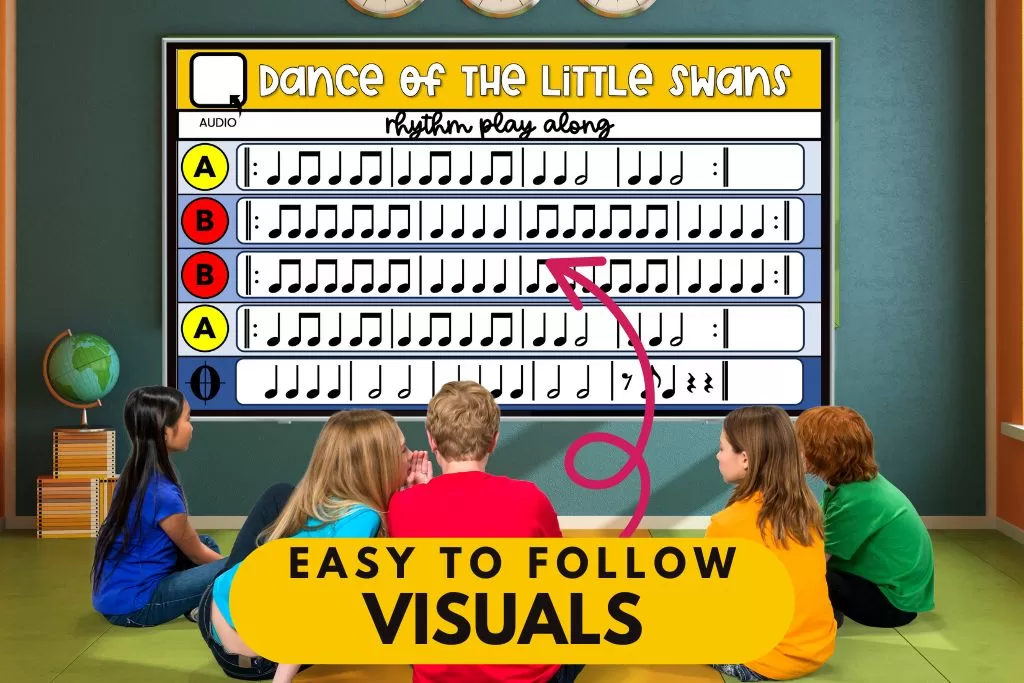
Another song from Swan Lake is the Dance of the Little Swans. I created a rhythm play along activity to go with this piece. It’s a great way to participate in a new song while reviewing rhythms students have learned.
Here is how I would recommend teaching a rhythm play along.
- Listen to the song first so students are familiar with the different sections.
- Look at the rhythms for each section. Read through them one section at a time to make sure everyone feels solid on their rhythm reading.
- Play the song and SAY the rhythms.
- Play the song and play the rhythms. It could be on a drum, or with made up body percussion or any number of other ways. You could have students be in charge of different sections. There are so many performance choices you and your students could make. It makes for some great discussions and helps your students feel involved in the process.
This rhythm play along visual is another resource included in the Tchaikovsky Music Unit Bundle.
Music of Tchaikovsky Sleeping Beauty
Let’s finish off our tour through the music of Peter Tchaikovsky with another very famous ballet – Sleeping Beauty. I think one of the reasons that the music from Tchaikovsky’s Sleeping Beauty remains so well-known to this day is that Disney used many of his melodies in their animated classic.
For this reason, I think it can be fun to compare the music from the ballet with the music in the Disney animated movie. Because, although Disney did use many themes from the ballet, they didn’t necessarily use them with the same characters. For example, the theme we often hear with Maleficent is – strangely enough – actually titled “Puss in Boots and the White Cat!”
At the end of the ballet, a bunch of fairy tale characters show up to congratulate Sleeping Beauty and her prince and shower them with gifts. You can watch a video snippet of Puss in Boots making his cameo appearance in Sleeping Beauty here. And perhaps compare it with this movie snippet of Maleficent casting her spell in the movie. What completely different uses of the theme!
It might even be fun to have a guessing game of what scene goes with what theme, because I definitely would have never guessed Puss in Boots!
Sleeping Beauty Waltz by Tchaikovsky
Without a doubt, the most famous theme from Sleeping Beauty is the Waltz. Disney even put words to it in their movie, so many of us know this song as “Once Upon a Dream.”
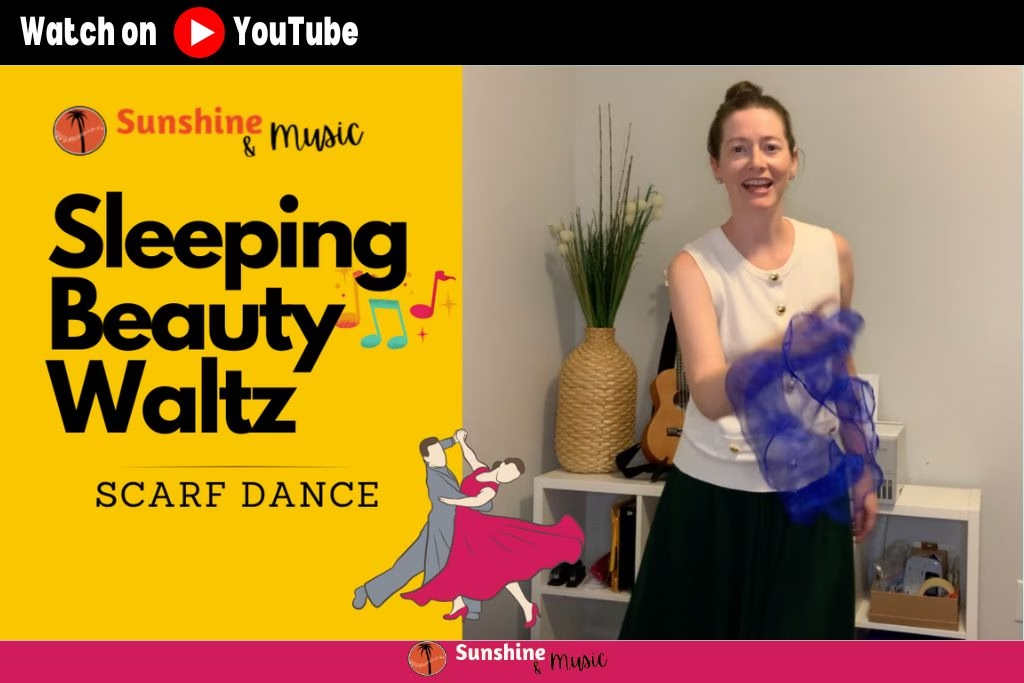
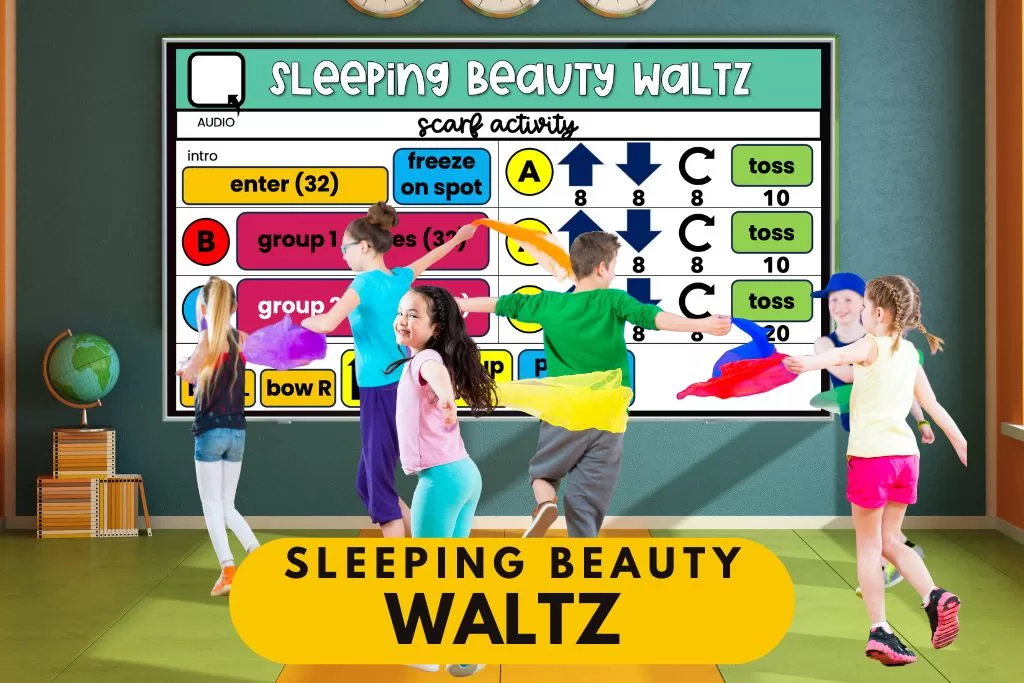
I created a scarf dance to go along with the Sleeping Beauty Waltz.
Here are the basic steps:
NOTE: You will need to divide your students into two groups before starting. They do not need to stand with their group. (It actually looks better if they are all mixed together). Groups could be based on scarf colors.
Intro: Students enter, grandly walking about the room for 32 beats. By the end of this section they should make their way to their spot and freeze.
A: Wave scarf and walk forward 8. Wave scarf and walk backward 8.
Turn in a circle 8 beats. Toss the scarf to the beat – 10 beats.
B: Group 1 moves/dances while group 2 is frozen.
A: Same moves as before
C: Group 2 moves/dances while group 1 is frozen.
A: Same moves as before but the tossing section is approx. 20 beats this time.
Coda: Bow L (2 beats). Bow R (2 beats). Wave scarf up and down with the melody. Pose on the last note.
Want to see it in action? Click here to watch the Sleeping Beauty Waltz Scarf Dance on YouTube.
What I like about this dance is that students don’t have to dance with a partner, which can be a barrier to entry for some students. I also find that if you put a scarf or ribbon or SOMETHING in students’ hands, they are more likely to move.
Again, I have directions and a helpful visual of the movements for this song available as part of my Tchaikovsky Music Unit Bundle, if you are looking to quickly and easily implement this in your classroom.
Sleeping Beauty March
If you like to dive into the less well known songs to balance out the famous ones, then I have a great one for you. This melody is still readily recognizable for anyone who has seen the animated version of Sleeping Beauty.
This theme is played when all the subjects in the kingdom are coming to celebrate the birth of Princess Aurora. In this case, the ballet uses the theme for the same purpose. Here is a clip from the animated movie showing this theme. I couldn’t find a clip specifically focusing on this scene in the ballet, but I could find a link to the FULL ballet and this theme pops up around 4:25 if you want to share it.
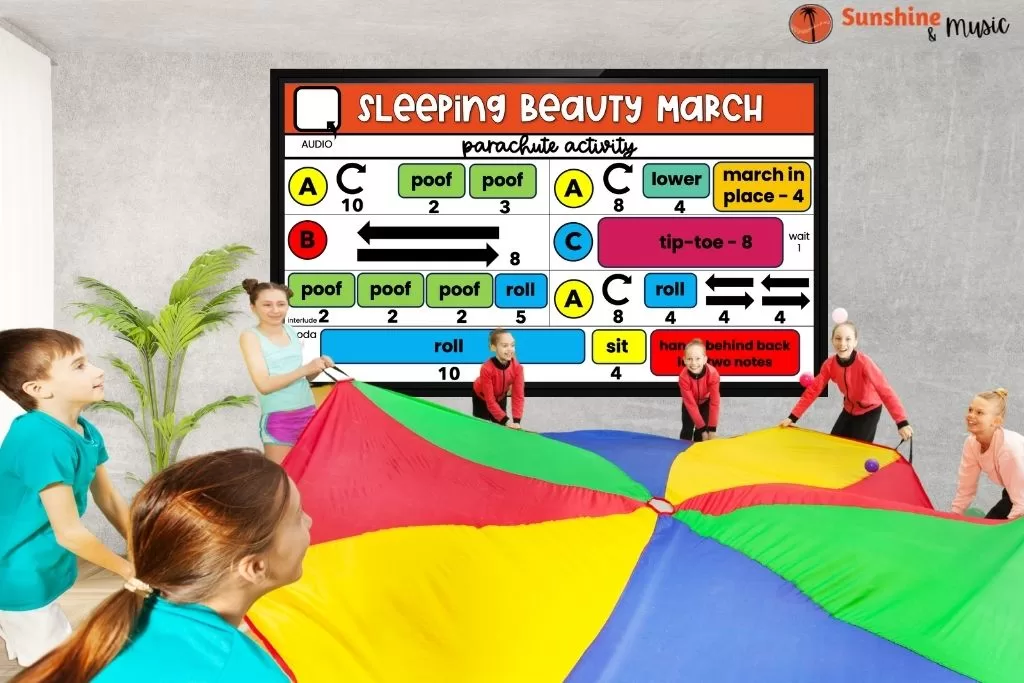
For this theme, I made another parachute routine. Here are the basic moves:
A: Hold parachute with left hand and walk in a circle. (10 measures)
Poof (parachute up fast on 1 and let settle for rest of the 2 m.). Repeat.
A: Hold parachute with left hand and walk in a circle. (4 m.)
Lower the parachute slowly towards ground. (4 m.)
Stand back up straight and march in place. (4.)
B: Move parachute side to side. (8 m.)
C: Hold parachute in left hand and tip-toe in a circle. (8 m.) wait 1 m.
interlude: Poof (parachute up fast on 1 and let settle for rest of the 2 m.). Repeat 2x.
Roll (hands move fast up and down). (5 m.)
A: Hold parachute with left hand and walk in a circle. (8 m.)
Roll. (4 m.)
Side to side. (8 m.)
Coda: Roll. (10 m.) Walk in a circle.
Sit down. (4 m.) Hands behind back on last two notes.
And, you guessed it! I have visuals for this activity too as part of the Tchaikovsky Music Unit Bundle.
Getting Started With Your Tchaikovsky Music Unit
Hopefully this blog post has given you ample ideas to get you started on creating your own unit on the music of Tchaikovsky.
But creating visuals and resources to go along with the whole unit can be time consuming. So if you are looking to save some time and gain some high-quality resources, I feel you! And I have created a Tchaikovsky Music Unit Bundle. It has everything you need, including:
- Visuals and explanations to 5 movement and rhythm activities
- Guided listening coloring sheets for 3 songs
- 5 Listening maps to famous works by Tchaikovsky
- 15 listening worksheets (3 for each song)
- 10 activities to learn about composer Pyotr Tchaikovsky
- A suggested set of lesson plans to tie it all together
Looking for a FREE lesson? I can help you with that too, even if it isn’t on Tchaikovsky. You can click the link below to get a free jazz mini-lesson that includes a listening map and rhythm play along.


One Response